
Tesla - Echolana 2
Tape echo, reverberator, delay.Original specifications according to the manufacturer:
- Supply voltage: 220 / 120 VAC
- Mains frequency: 50 Hz
- Principle: Endless magnetic tape loop, 470 mm
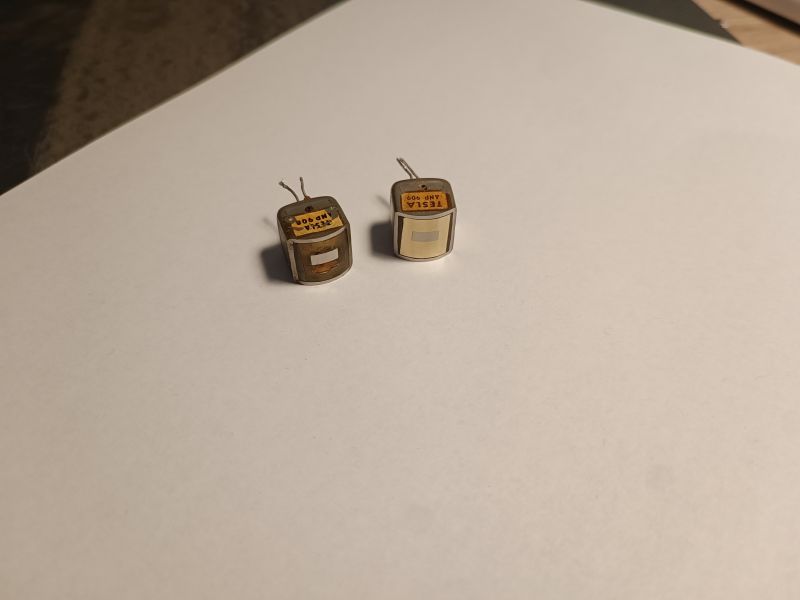
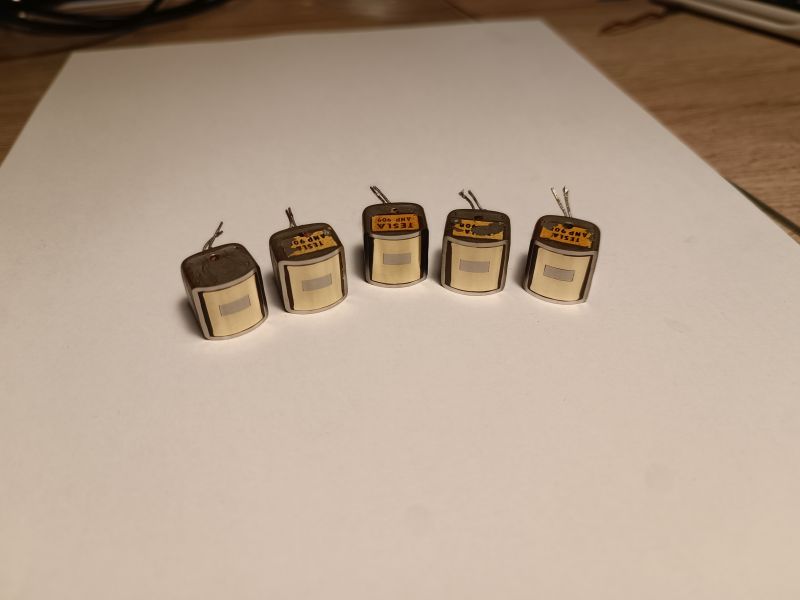
- Tape heads: 1x erase ANP907, 1x record ANP909, 4x playback ANP908
- Tape speed: 39 cm/s
- Frequency range: 50 ... 12000 Hz @ ±3 dB
- Inputs: 2x microphone (0.8 / 4 mV @ 2 kΩ), 1x guitar (40 mV @ 100 kΩ)
- Output: 300 mV @ 500 kΩ
- Case material: Steel sheet
- Weight: 7 kg
- Dimensions: 305 × 115 × 225 mm
In this historical section, we describe devices manufactured in former Czechoslovakia by the national companies Tesla, n.p. and Elektroakustika Bratislava. Not everything old is necessarily bad. It just takes a little "love" and time, since these devices often come in poor condition.
Description
The first pictures show the original condition of the device. Importantly, the main motor started rotating quietly after switching on, and all tape heads were present. Renovation of the device was therefore possible and, as a form of psychohygiene from other projects, even necessary! Echolana 2 is equipped mainly with germanium transistors, but for its time it had modern, low-noise silicon KC509 transistors in the input preamplifiers.


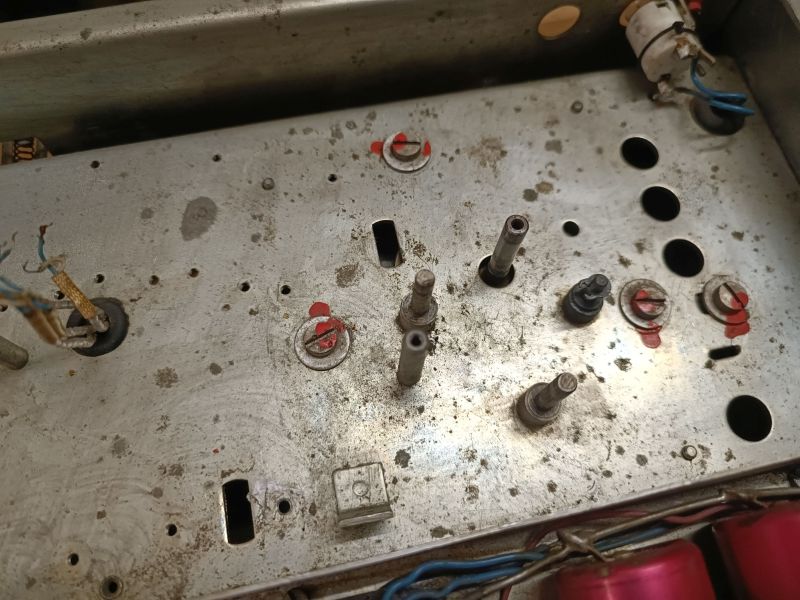
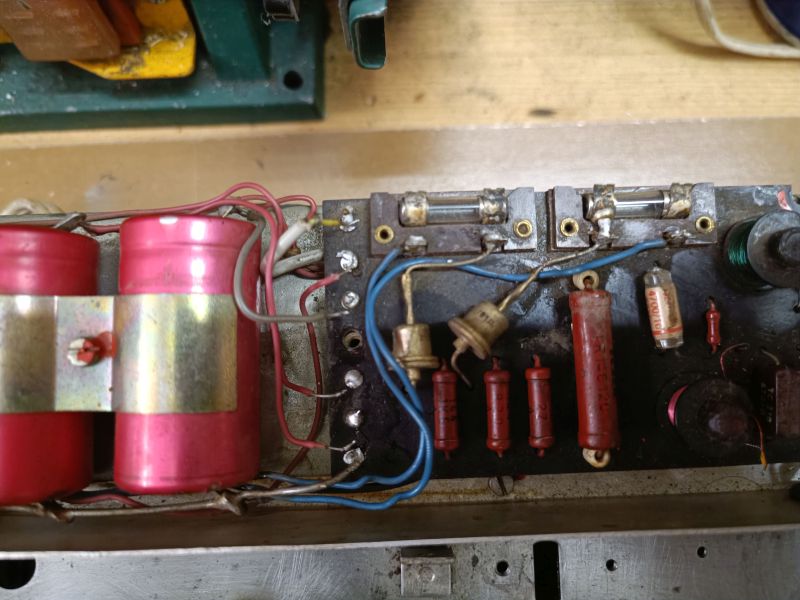


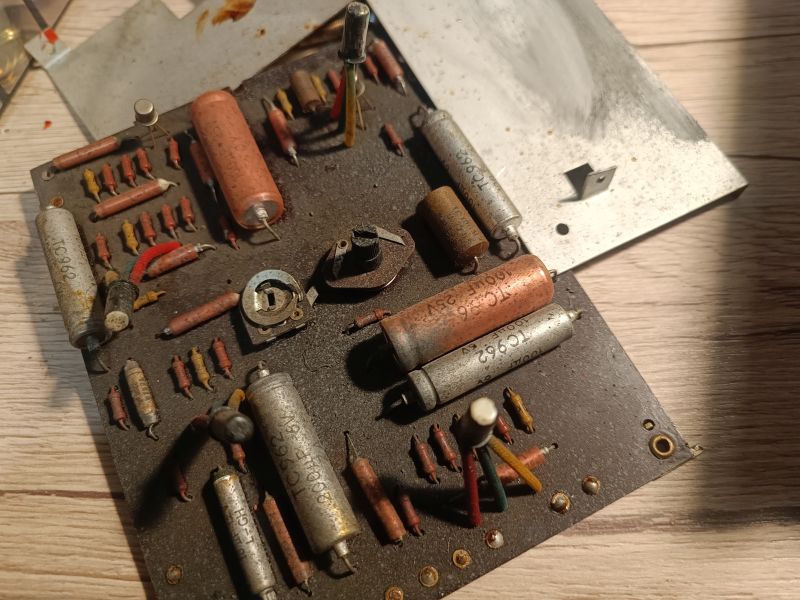
I decided to brush and oil-protect the chassis. This wasn’t extra work, since the heads had to be removed anyway for relapping, along with the pinch roller system and loosened tension arm. I wouldn’t have been satisfied if I had put refurbished heads and mechanics back on a chassis in such a state. The power supply and HF board were cleaned with alcohol and problematic capacitors were replaced with period-correct film types, still in good condition. The large electrolytic filter capacitors were measured for capacitance and ESR at 100 Hz / 100 kHz — all perfectly fine. If only today’s capacitors performed this well after more than 50 years! One trimmer had a broken slider, so I replaced it with a vintage ceramic one.

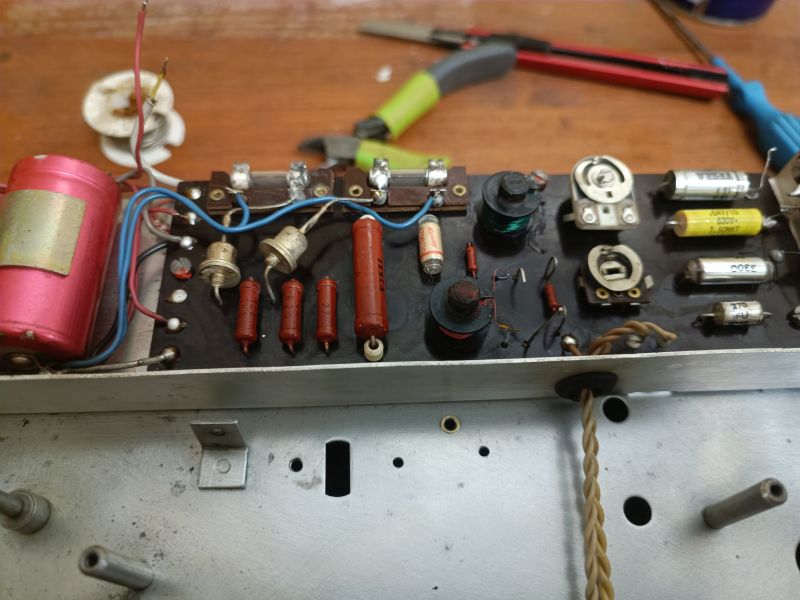
The head switching system is cleverly designed, though I wasn’t satisfied with the execution — common at the time. I at least added insulation so wires wouldn’t touch each other accidentally. The switches had to be cleaned with Kontak 60 and then 61. The pressure roller was crumbled, so I used a Revox roller core with new rubber covering, which I trued on a lathe to reduce wow & flutter.


The tape heads were removed from their shielding cans, which I also brushed clean with brass brushes. High-permeability materials like these don’t like aggressive treatment, but brass is fine. After relapping, the difference was obvious — the worn heads had been ground into a trapezoid by the tape, meaning they were tilted. This caused problems in tape path alignment and signal quality. After remounting, height alignment, zenith, and azimuth had to be carefully adjusted to ensure proper HF response.



Now, people who like to preserve original condition should stop reading — but from a practical standpoint I made some modifications. Since someone had already drilled out the rivets on the DIN connectors, I replaced them with RCA. More importantly, Echolana 2 has extremely sensitive inputs (in mV range) and high output impedance — very impractical. I reduced the input sensitivity by adding feedback to the input transistor KC509 (gain ~ 1). For the output I added an emitter follower to keep the discrete design. Other functions and topology were preserved.


Below is a short demo of how Echolana 2 sounds. Please be tolerant of the audio/video quality — the goal wasn’t studio recording, but it’s enough to give the viewer an impression. In the next article, we’ll look at the Tesla EMP 124, a mixing console by Elektroakustika Bratislava of very high quality, featuring input/output transformers and inductor-based tone control. Quite an extraordinary design for its time.