
Tesla - EMP 124
Service manualMixing console Elektroakustika Bratislava.
- Supply Voltage: 220 / 120 VAC
- Line Frequency: 50 Hz
- Number of Inputs Line / Microphone: 12
- Type of Inputs / Outputs: Transformer
- MIC Input Parameters: Zin = 2k, balanced, 0.25 to 250 mV
- LINE Input Parameters: Zin = 10k, balanced, 0.25 to 2.5 V
- Overload Capacity: 30 dB
- Equalizer: 3 bands, parametric mid frequencies, stepped
- Output Impedance: < 35 Ω
- Noise Voltage Level: -80 dB
- Weight: 37 kg
- Dimensions: 846 × 510 × 145 cm
This historical window describes devices manufactured in the former Czechoslovakia by the national enterprises Tesla or Elektroakustika Bratislava. Not everything old is necessarily bad. It just requires some "care" and time, as many items are in a deteriorated state.
Description
A few words about the device, since information online is limited. The EMP 124 mixing console was designed for small radio nodes, theaters, clubs, etc.
Due to its compact size, weight, and connectivity, it can also be used as a portable device.
The console features 12 universal input modules and 4 output modules.
Each input module is equipped with balanced microphone and line inputs, a three-band equalizer, a peak indicator, and a level control.
The modules can operate in mono or stereo mode.
The signal from each input module can be routed to 4 output buses as well as to ECHO, CUE, and SOLO buses. The ECHO signal can be processed externally and returned to the output buses.
Output modules provide balanced line output, control output, and auxiliary output. An integrated signal generator facilitates checking the transmission path. All circuits are powered by an internal power supply located under the level indicators. Access is via removal of the bottom cover.
Some photos of the found condition are shown below. The console is complete, and missing channels were temporarily removed for inspection.

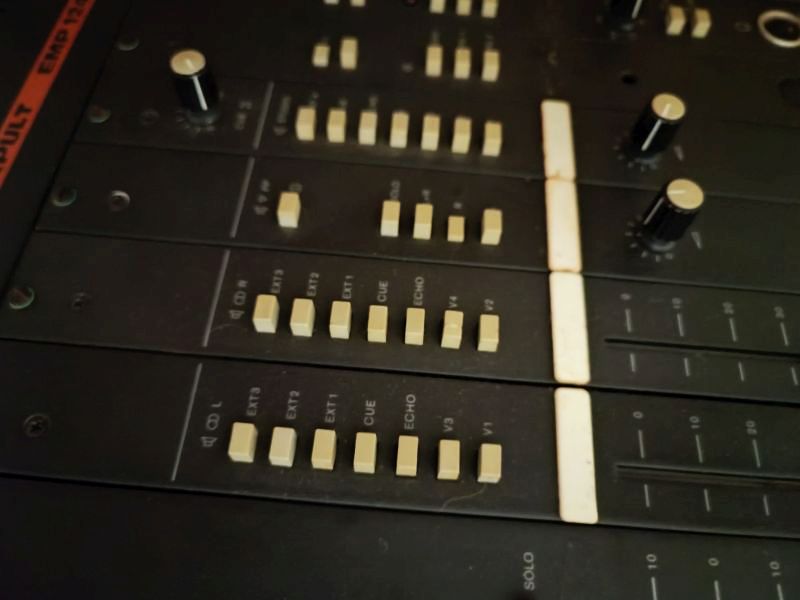
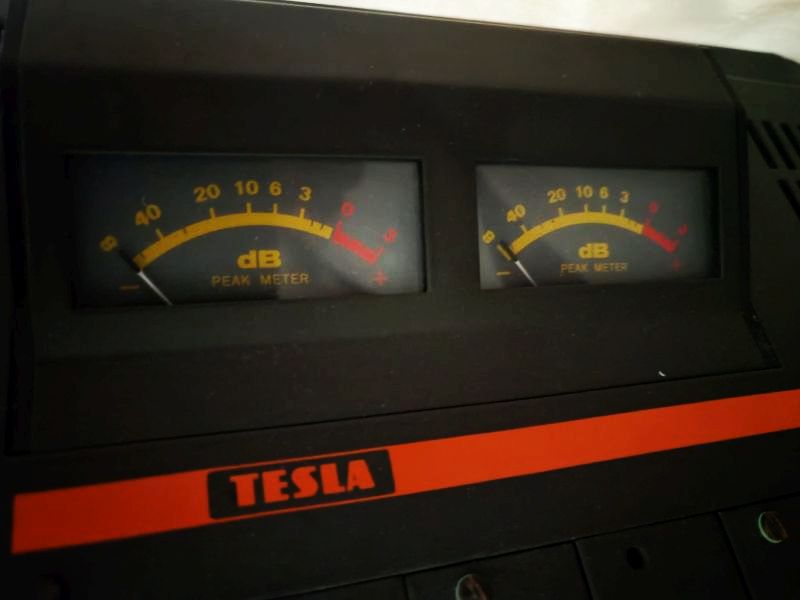

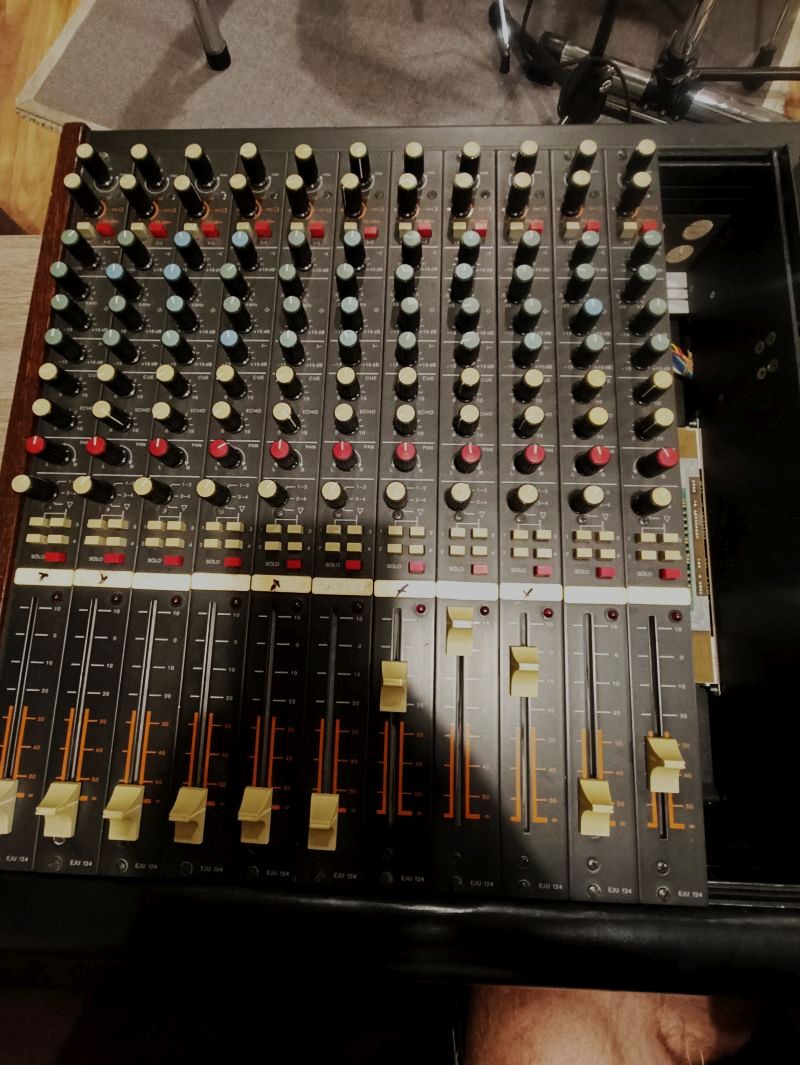
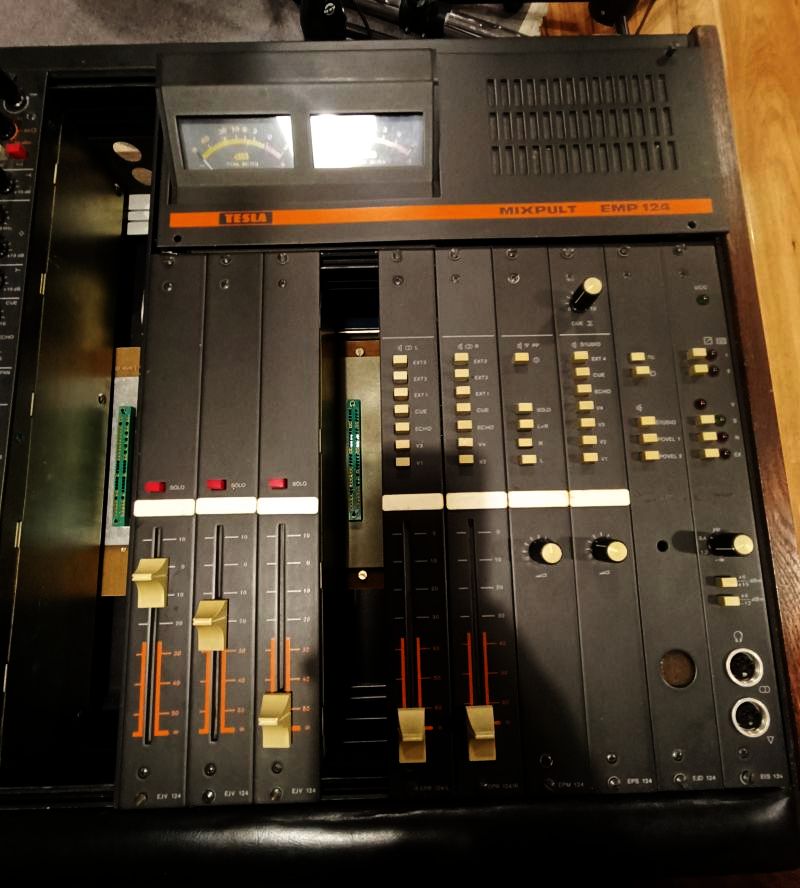
What first caught my attention is that each channel has a transformer at the input, which is excellent for sound character, overload, and galvanic isolation. Another surprising aspect is the use of RCA operational amplifiers LM748. They must have been expensive! Tesla at the time used their own MAA741 or 748, whose parameters could not match Western products. Only MAA501 remains in the peak detector - acceptable.
The level control / attenuator / fader is built very robustly. The feel is very smooth. In the "infinite" position, there is even a micro-switch for "Fader-start" signaling. Potentiometers are in robust sealed cermet housings.
Tesla electrolytic capacitors were measured, and capacitance and ESR are OK. In the audio path, foil capacitors are used, attenuation is smooth, but mid-frequency selection is stepped - excellent! Ceramic capacitors are only for basic power supply filtering.
The only concern is the problematic green resistors - prone to failure during soldering as the leads can detach. Hopefully they remain reliable.


The peak signal indicators are mechanically very robust, labeled "shock-resistant". They are PPM, not VU; the needle response is very fast, and fall time about 1 s, which corresponds to PPM definition.

The power supply is modular, allowing removal without soldering. Stabilization is via op-amps and transistors. Filter capacitors are in excellent condition. Transformer lamination is silent. Transformer is correctly designed with low magnetization current.

The mixing console is assembled on ALMES profiles, which facilitates channel strip alignment and positioning, but requires care when screwing nuts. Soldering quality is excellent; PCB has a good finish.


This concludes the basic description at first glance. Below are the factory technical specifications. Restoration is in progress. No changes are planned, including legacy DIN connectors. These are high-quality, metal-cased, with lockable counterparts. 5-pin DIN plugs are an advantage; why?
The problem is that EMP 124 lacks Direct Out outputs, which are required for track recording. Whether analog or digital, I will carefully add DO outputs using a line DIN connector for both input/output, without rough modification to the console.
Technical Specifications
Dimensions: 846 × 510 × 145 mm
Weight: 37 kg
Power Supply: AC, 127/220 V, 50/60 Hz
Max. Power: 45 VA
Operating Conditions:
- Ambient Temperature: -10 to +55 °C
- Relative Humidity at 18 °C: max. 80 %
- Ambient Magnetic Induction: 5•10⁻⁶ T
Electrical Parameters
Low-level Input (microphone): balanced
Number of Inputs: 12
Nominal Input Voltage, mV: 0.25 to 250
Overload, dB: 30
Source Impedance, Ω: 200
Input Impedance, kΩ: 1
Equivalent Noise Voltage at Input (20 kHz band), dBm: -124
Gain Range, dB: 60
- stepped, dB: 60, 40, 20
- continuous, dB: 20
High-level Input (line): balanced
Number of Inputs: 12
Nominal Input Voltage, V: 0.25 to 2.5
Overload, dB: 30
Source Impedance, Ω: 600
Input Impedance, kΩ: 10
Continuous Gain Range, dB: 20
Equalizer: three-band
Boost / Attenuation Control: continuous
Control Range, dB: ±15
Mid Frequencies (switchable), Hz:
250, 350, 500, 700,
1000, 1400, 2000,
2800, 4000, 5600,
8000
- upper, kHz: 12
Mid Frequency Tolerance, %: ±10
ECHO Input: balanced
Number of Inputs: 1
Nominal Input Voltage, V: 1.55
Input Impedance, kΩ: 10
Outputs
Main Outputs and ECHO Output: balanced
Number of Main Outputs: 4
Number of ECHO Outputs: 1
Nominal Output Voltage, V: 1.55
Minimum Output Voltage, V: 0.60
Output Impedance, Ω: 35
Load Impedance, Ω: 200
Signal-to-Noise Ratio (20 kHz band), dB: -80
Total Harmonic Distortion (load 200 Ω, output voltage 6.2 V):
- at 40 Hz, %: 0.5
- at 1 kHz, %: 0.1
- at 10 kHz, %: 0.2
Frequency Range, Hz: 31.5 – 16 000
Amplitude-Frequency Response Deviation, dB: ±0.5
Maximum Gain (input–output), dB: 96
Still in the procces of reconstruction